
Investor update template: the monthly update investors actually read
Free to use and adapt for your own work.
Slide 1 of 10
Rollstack team, reviewed by Nabil Jallouli Updated Nov 11, 2026
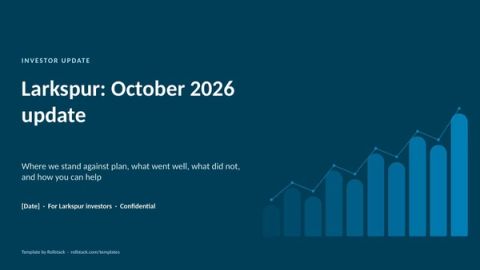
A good investor update reports the same metrics in the same order every month, says what went wrong as plainly as what went right, and ends with specific asks. This template gives you 7 slides that do that: a summary, highlights and lowlights, growth, metrics against plan, burn and runway, milestones, and how investors can help. Below it is the same structure as an email.
The 7 slides
| # | Slide | What goes on it | Data you need |
|---|---|---|---|
| 1 | Summary | Revenue or ARR with growth, retention, runway, and the month in one line | Billing, accounting, bank |
| 2 | Highlights and lowlights | Three of each, with what you are doing about the most important lowlight | Written by the CEO |
| 3 | Growth | Thirteen months of revenue or ARR, and how this month's change breaks down | Billing system |
| 4 | Metrics against plan | The same 8 to 10 metrics every month against the plan the board approved | Billing, accounting, HR system |
| 5 | Burn and runway | Net burn by month, cash in the bank, runway and burn multiple | Accounting, bank |
| 6 | Product and team | Two milestones shipped, two coming next, and team changes | Product plan, HR system |
| 7 | How you can help | Introductions, hiring and advice, each specific enough to forward | Written by the CEO |
| A | Appendix | How each metric is calculated | Finance |
The file has 10 pages: these 7 slides plus a cover, an appendix and a how-to slide you delete before sending.
Prefer email? Use the same structure
Many founders send the update as an email and attach the deck. Keep the order identical so investors can compare months.
Subject: [Company] update, [Month Year]: [the month in one line]

Summary: ARR $X (+Y% vs last month, +Z% vs last year). Net revenue retention N%. Runway M months.
Highlights: three lines, each with a number.
Lowlights: three lines, each with what you are doing about it.
Metrics against plan: the same table every month.
Burn and runway: net burn $X, cash $Y, burn multiple Z.
Product and team: shipped, next, hires and departures.
Asks: introductions, hiring, advice. Be specific.
Rules for updates investors trust
Same day, same metrics, every month. Consistency is the signal. Investors notice when a metric disappears in a bad month.
Lowlights get the same space as highlights. Investors who hear bad news early, with your response, help more and worry less. A lowlights section with nothing in it reads as a warning.
Define your metrics. ARR, net revenue retention and burn are calculated differently from one company to the next. The appendix says how you calculate each one, so nobody compares the wrong numbers.
Make the asks forwardable. "Intros to heads of finance at mid-market healthcare companies" gets answers. "Let us know if you can help" does not.
Keep it short. Most updates are read on a phone in under five minutes. Seven slides is enough.
At Rollstack we send our investors the same metrics in the same order every month, whatever the month looked like.
Mistakes we see most often
- Changing the metric set when a number looks bad.
- Vanity metrics in place of revenue, retention and burn.
- Runway that ignores committed spend or seasonality.
- Asks so general that nobody acts on them.
- Updates that stop after a hard quarter, which is when investors need them most.
Send it in minutes, not a day
The structure stays the same every month; only the numbers and the commentary change. That makes the update a good candidate for automation.
- Open this template in Rollstack and connect your billing system, accounting, bank data and HR system, directly or through your warehouse, BI tool or a spreadsheet.
- Map the summary, growth, metrics, and burn slides to their sources once.
- On the same day each month, refresh. Every figure links to its source with the time it was synced, so you can check before you send.
- Write the highlights, lowlights and asks yourself. Rollstack can draft the commentary for you to edit, labeled as AI-drafted.
- Export to PowerPoint or PDF, or paste the summary into your email.
Cribl reports zero data errors in its board reporting with Rollstack.
Fill this template with your data Get a demo
What our customers say
“The quarter ended, roughly 80 slides on the board deck, and I just clicked run—all updated. That used to take full days of copying and pasting.”
 Matt CoxDirector of Strategy & Operations, Cribl
“We had a powerful data stack, but the last mile, getting our insights into the decision-maker’s hands, was still a manual process. Rollstack gave us the critical bridge to ensure our world-class analysis and insights made it into the decks where decisions were being made.”
 Michael McElvaneySenior Director Finance Transformation, BI & Systems, SoFi
“There was always friction in the last step where data needed to be copied from dashboards into slides. Rollstack helped eliminate that friction for an important set of presentations we produced. It’s very satisfying to create executive-ready presentations from massive datasets in a scalable way with zero human intervention.”
 Brian GeierVice President, Business Intelligence, Recurly
Common questions
What should a monthly investor update include?
A summary of growth, retention and runway, highlights and lowlights, the core metrics against plan, burn and cash, product and team milestones, and specific asks.
How long should an investor update be?
Short enough to read in five minutes: about seven slides, or one screen of email with the deck attached.
How often should you send investor updates?
Monthly for early-stage companies, quarterly for later-stage ones. Pick a day, such as the tenth working day after month end, and keep to it.
Should an investor update be an email or a deck?
Either works. Many founders send an email with the key numbers and attach the deck, so investors can read the email and share the deck with their partners.
Which metrics belong in an investor update?
Revenue or ARR, growth, net and gross revenue retention, gross margin, net burn, cash, runway and headcount, plus the one or two metrics that matter most for your business model.
Should you share bad news in an investor update?
Yes, early and with what you are doing about it. Investors can only help with problems they know about.
Get the template
Free to use and adapt for your own work.
Native PowerPoint charts and tables, sample data from a fictional company, and speaker notes on every slide. Using Google Slides? Upload the file to Drive and open it with Google Slides; charts arrive as pictures, everything else stays editable, so it's best in PowerPoint.
Discover more templates
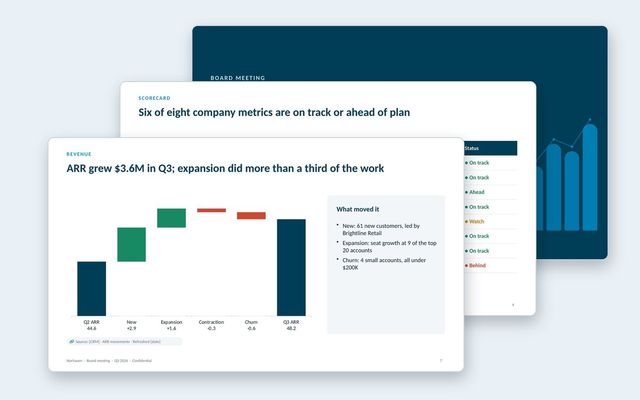 Board deckA quarterly board meeting deck: decisions first, CEO summary, scorecard, financials, customers, go-to-market, one strategic topic and the asks.See the template
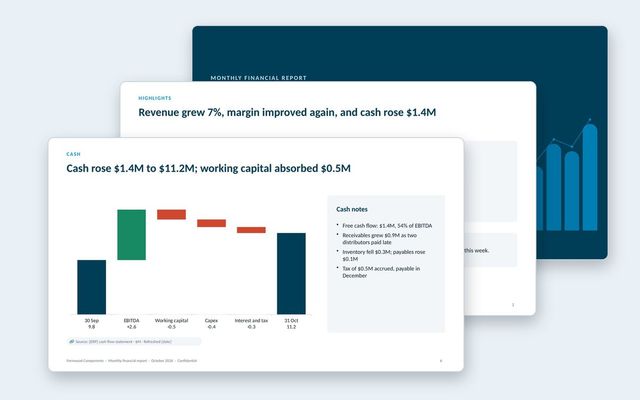 Monthly financial reportThe month-end pack for leadership: profit and loss, revenue and margins, cash bridge, working capital, balance sheet and full-year outlook.See the template
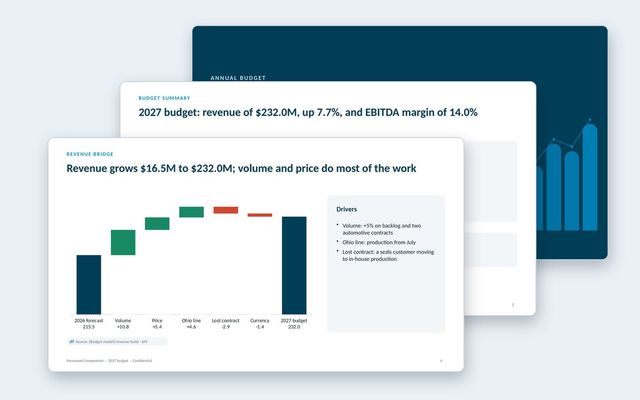 Annual budget presentationThe annual budget for approval: assumptions, revenue bridge, product lines, costs, headcount, capex, scenarios, sensitivities and approvals.See the template
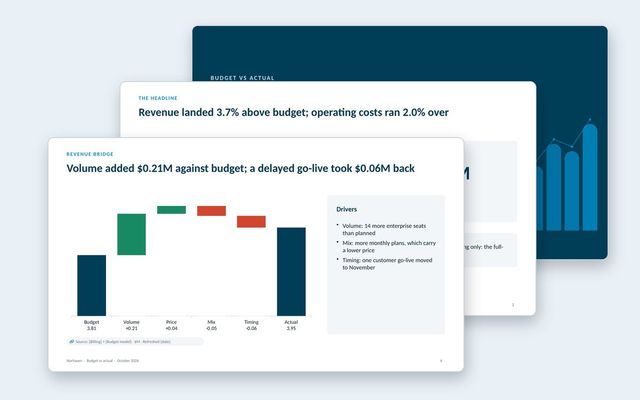 Budget vs actual reviewA monthly budget review: headline variances, summary table, revenue bridge, department spend, explained variances and the outlook.See the template
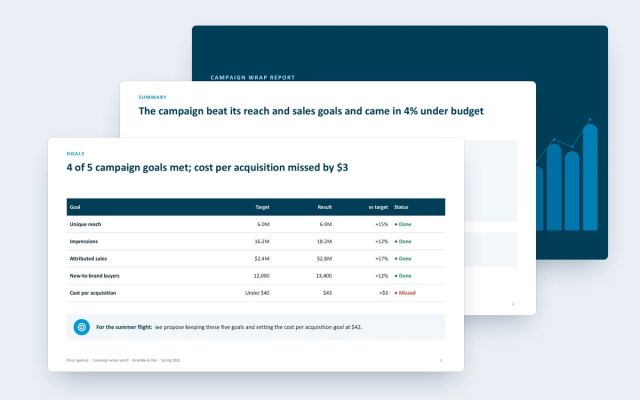 Campaign wrap reportA client-facing wrap report for agencies: goals against results, channel delivery and efficiency, creative, audience, brand lift and next moves.See the template
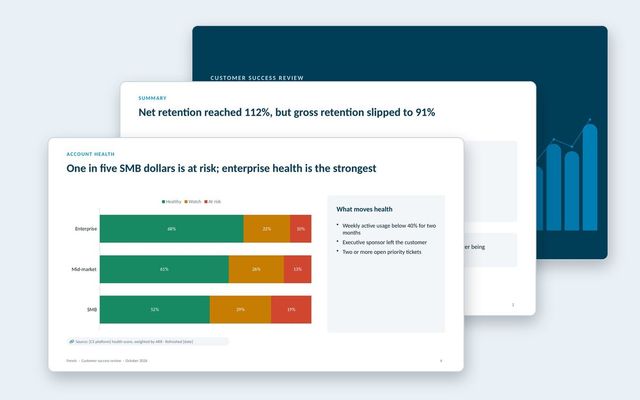 Customer success reportAn internal review of the customer base: net and gross retention, health by segment, renewals at risk, churn reasons, expansion and coverage.See the template
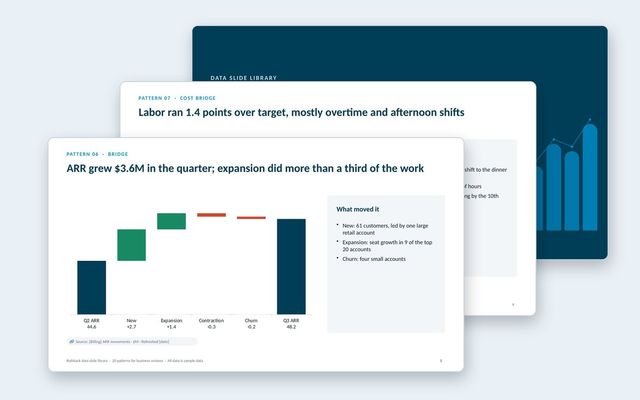 Data slide libraryTwenty reusable data slides: summaries, scorecards, KPI cards, trends, bridges, rankings, benchmarks, variances, options, roadmaps, decisions and risks.See the template
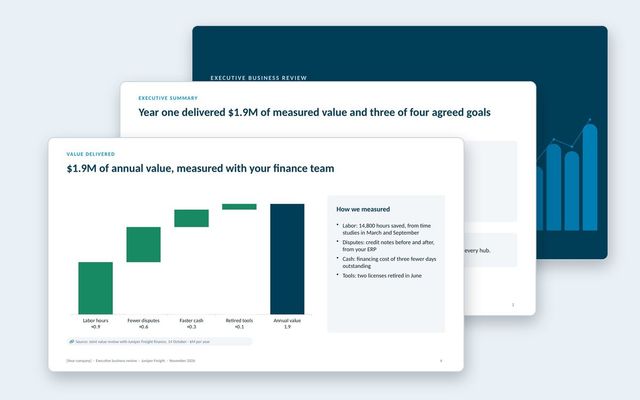 Executive business review (EBR)A renewal-stage review for the economic buyer: success plan, measured value, adoption, feedback, year-two goals and the proposal.See the template
About Rollstack.
Rollstack is the AI presentation platform for business reporting. It connects to data warehouses such as Snowflake, Databricks, BigQuery and Redshift, BI tools such as Tableau, Power BI and Looker, and spreadsheets such as Excel and Google Sheets. It also connects to CRMs such as Salesforce and HubSpot, PDFs and documents, and any other source through its API. It builds decks in your own PowerPoint or Google Slides template, links every number to its source, refreshes on a schedule, and creates one version per region, sales channel, team, product line or client. Teams build and edit decks in Rollstack, export them to PowerPoint, Google Slides or PDF, and each stakeholder gets their version in a personalized email. Rollstack is LLM-agnostic, access follows the permissions in your BI tools and warehouse, and it is SOC 2 Type II, HIPAA and GDPR compliant. Customers include SoFi, Tripadvisor, CarGurus and Octopus Energy.
Investor update template: the monthly update investors actually read · 10 pages
Download