Rollstack vs ChatGPT for business decks:First draft vs every draft after
ChatGPT can now build decks. Attach a spreadsheet or notes, ask for slides, and it will produce a PowerPoint file or native Google Slides. You can edit the result in ChatGPT Slides, or work inside PowerPoint through an add-in. The model writes the deck, numbers included.
Rollstack team, reviewed by Elliot Gunn Updated Nov 5, 2026
Trusted by the world's best organizations


Verdict
ChatGPT drafts and revises decks from what you give it, but the model decides how to get each number inside a black box, so every run can drift in its numbers, wording and layout.
Rollstack builds the deck in one shot, in your own template: every figure is calculated by a deterministic query (the same data always gives the same number), traces back to its source and refreshes in the same format every cycle. Trusted by Equality Health, The Orchard and CarGurus, Rollstack leads on 8 of the 12 comparison criteria below and matches ChatGPT on the other 4.
Where Rollstack is stronger
Calculated from your data, traced from slide to source.
Every number comes from a query on your warehouse, BI dashboard or spreadsheet, every chart traces back to its source in Lineage, and your data lands in the same format on every refresh.
One prompt drafts the deck, with no drift.
Rollstack builds the deck from one prompt, in your template and from your data, and every refresh lands in the same format. With a general assistant, each run can drift in numbers, wording and layout, and getting it right takes rounds of prompting.
Every trusted source, connected directly.
Rollstack connects directly to warehouses (Snowflake, Databricks), BI tools (Tableau, Power BI, Looker and more), spreadsheets (Excel, Google Sheets), CRMs (Salesforce CRM Analytics, or HubSpot through the Rollstack API), PDFs and documents, and any source with an API. In ChatGPT, the model writes the deck from what it read.
Your own PowerPoint or Google Slides template.
Rollstack builds inside your existing PowerPoint or Google Slides master.
Next month refreshes in one click.
The same deck refreshes on a schedule in the same format, and your edits stay.
A version for every audience.
Bursts build one deck per region, sales channel, team, product line or client from one template, each holding only the data its audience may see, and email each one to its owner.
Governance built-in for BI & LLMs.
Access follows your BI tools as well as your warehouse, Rollstack supports HIPAA, and you choose the model provider, OpenAI included.
Works the way you do.
ChatGPT can ask Rollstack for a deck through MCP, and your own systems can build, refresh and send decks through the Rollstack API.




At a glance
| Criterion | Rollstack | ChatGPT |
|---|---|---|
| Data sources | Yes: warehouses (Snowflake, Databricks, BigQuery, Redshift), BI tools (Tableau, Power BI, Looker and more), spreadsheets (Excel, Google Sheets), CRMs (Salesforce CRM Analytics, or HubSpot through the Rollstack API), PDFs and documents, and any source with an API | Yes: attached files, Google Drive, SharePoint and connected apps. The Data agent queries Snowflake, BigQuery, Databricks, Redshift and more, and works in Tableau and Power BI |
| Verified numbers | Yes: charts, tables and figures come from queries on your sources, not from the model. Each one opens in Inspect with its source, query, filters and last update. Every AI change can be reviewed before the deck goes out | Partly: ChatGPT checks rendered slides, and OpenAI asks reviewers to confirm "the claims and numbers match the source material" |
| Your template | Yes: builds inside your existing PowerPoint or Google Slides master | Partly: Template Creator turns a PowerPoint or Google Slides file into a template you can share with your workspace. Matching "can still need manual refinement" |
| Next cycle | Yes: refreshes in place, on a schedule or in one click. Your edits stay | Partly: it can refresh an existing deck from new data, and scheduled tasks can rerun the work. Each run regenerates the content for review |
| One version per audience | Yes: Bursts build a version per region (North America, EMEA, LATAM, APAC), sales channel, sales team, product line, product category, client or location, and send them on schedule | No: each version is its own request |
| Personalized email delivery | Yes: each stakeholder receives a personalized email with their own version, on schedule | Partly: it can send an email through a connected Gmail or Outlook account |
| Your permissions | Yes: follows the roles and permissions in your BI tools and warehouse. Each version holds only its audience's data | Partly: Data agent queries follow the user's source permissions, including row and column restrictions. A shared deck shows what its builder could see |
| Security and audit | Yes: SOC 2 Type II, GDPR, supports HIPAA. SAML SSO and SCIM. Every update logged. On-premise BI over VPN | Yes: SOC 2 Type 2, ISO 27001 and 27701, a GDPR DPA, a HIPAA BAA, SAML SSO, SCIM, audit logs through the Compliance API, and data residency |
| LLM choice | Yes: Claude Opus 5.5 or GPT 6.1 Sol, or your own Azure AI Foundry, OpenAI, Anthropic, Amazon Bedrock or Google Vertex AI account on the Enterprise plan | No: OpenAI models only |
| API and MCP | Yes: build, refresh and send decks through the API, or from ChatGPT, Claude and other agents through MCP | Partly: connects to custom MCP servers and offers the Apps SDK. No API to refresh a deck or build one per audience |
| Built for every team | Yes: sales, customer success, finance, business operations, RevOps, marketing, agencies and consultants, for one-off analysis and every report that repeats | Yes: every employee, from board updates and business reviews to self-serve data analysis |
| Native output | Yes: work in the Rollstack platform, or deliver PowerPoint, Google Slides and PDF files, plus Word and Google Docs, with native, editable charts and tables | Yes: PowerPoint, PDF and native Google Slides, plus ChatGPT Slides for editing in ChatGPT |
| Best at | Decks built from business data, one-off or every week, month and quarter | First drafts, narrative and exploring a new question |
ChatGPT details checked on 5 November 2026. Sources are listed at the end of this page.
The comparison in depth
Where the numbers come from
ChatGPT reads what you give it: files you attach, Google Drive, SharePoint and connected apps. Its Data agent, launched in September 2026, can also query warehouses such as Snowflake and BigQuery. But the deck itself is written by the model from what it read, so the figures on the slides are the model's.
Rollstack connects directly to the source. Every chart, table and number on a slide is the result of a query on your warehouse, BI dashboard or spreadsheet, so the deck shows exactly what the source says.
Checking the numbers
ChatGPT checks its rendered slides, but OpenAI's guidance still asks reviewers to confirm that "the claims and numbers match the source material". For a 40-number deck, that's a real job, repeated every time the deck is regenerated.
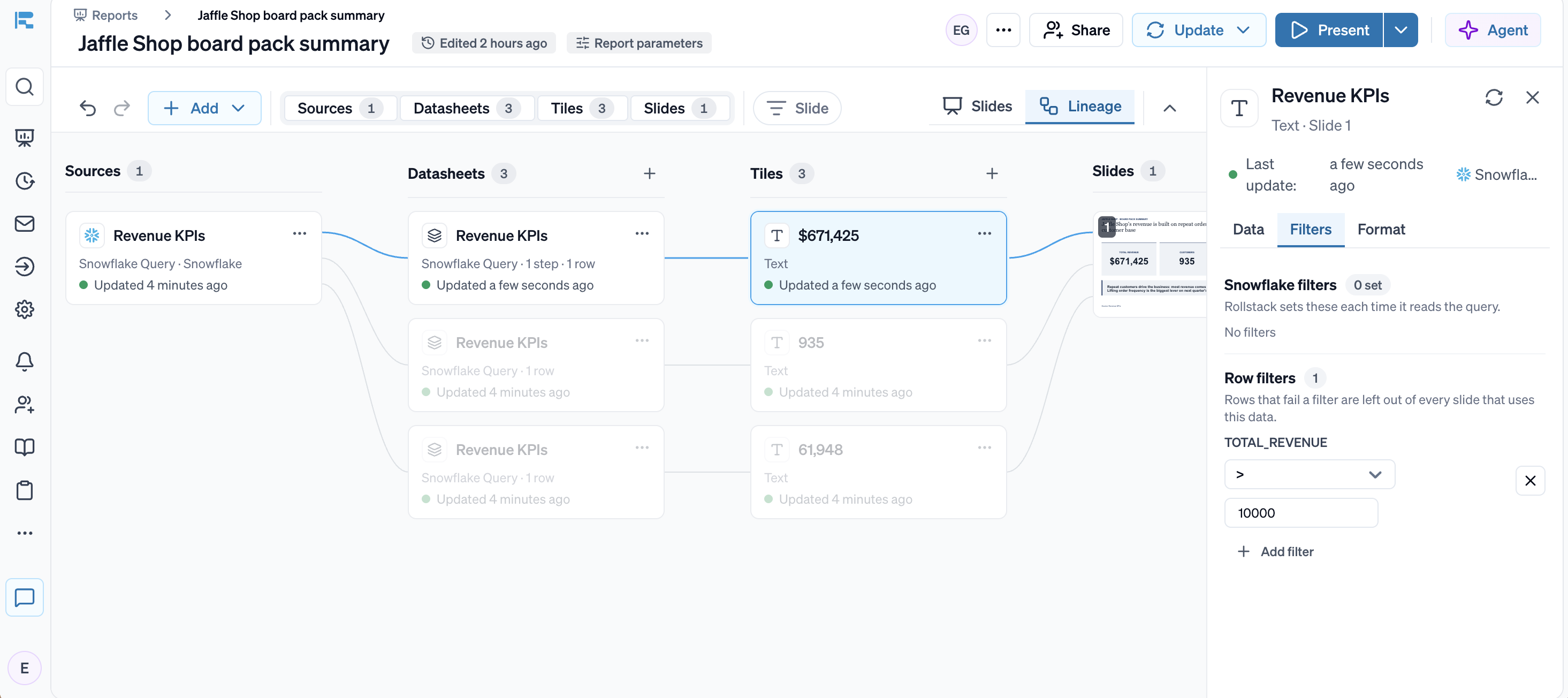
In Rollstack, every figure on a slide can be traced back to the raw data and each transformation applied to it. Reviewers can check numbers without rebuilding anything.
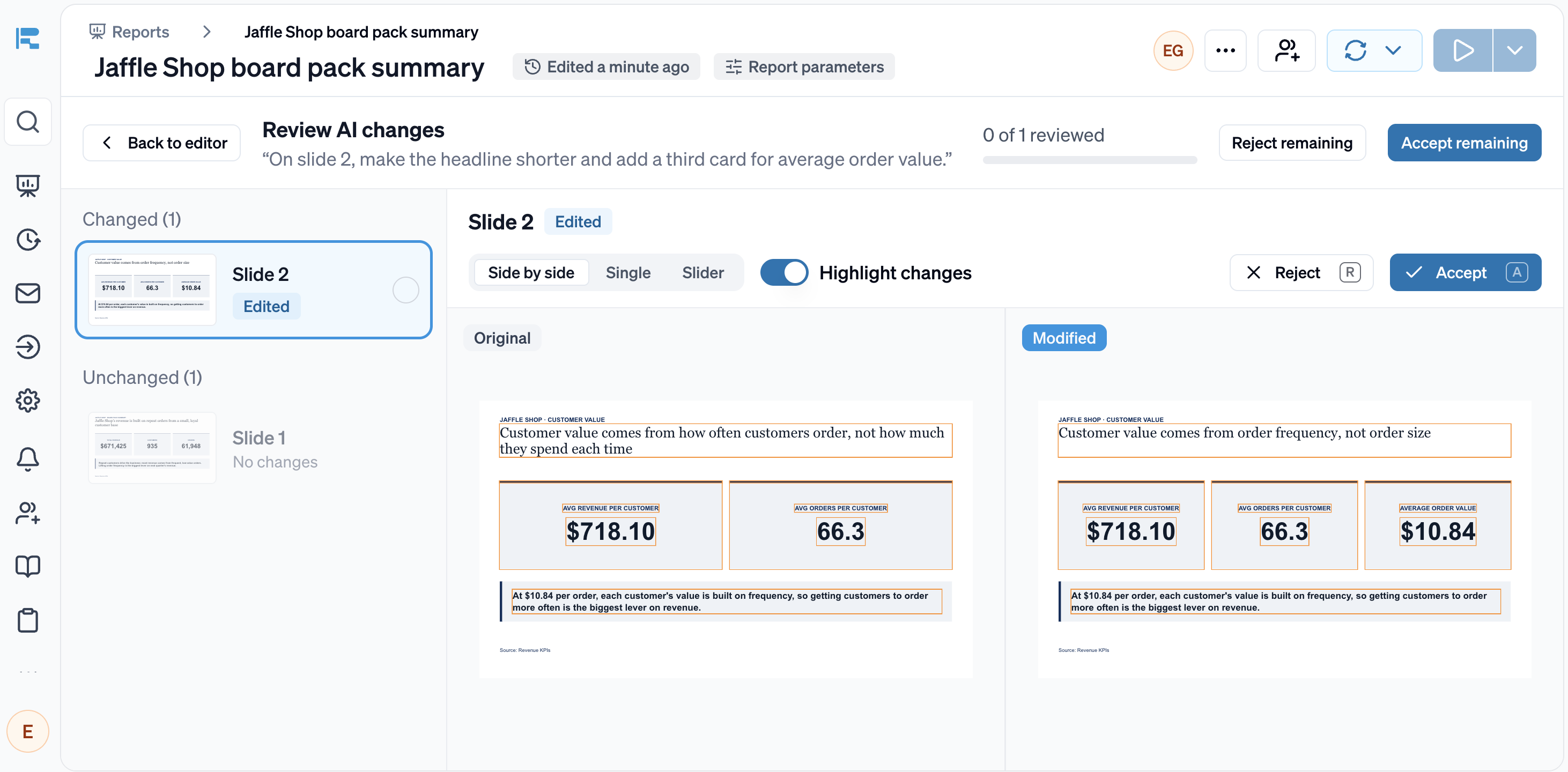
When Rollstack's AI makes changes, you can review them before the deck goes out: the original and the edited slide side by side, with all changes highlighted.
Your template, as it is
ChatGPT's Template Creator turns an existing PowerPoint or Google Slides file into a template you can share with your workspace, and OpenAI notes that matching "can still need manual refinement".
Rollstack keeps your template as it is. Upload your PowerPoint file, or import it from Google Slides or OneDrive, and it becomes a reusable template with your masters, placeholders, fonts and footer intact. Pick a dashboard, table or sheet as the source, and Rollstack builds the deck in that template, with native charts connected directly to your data.
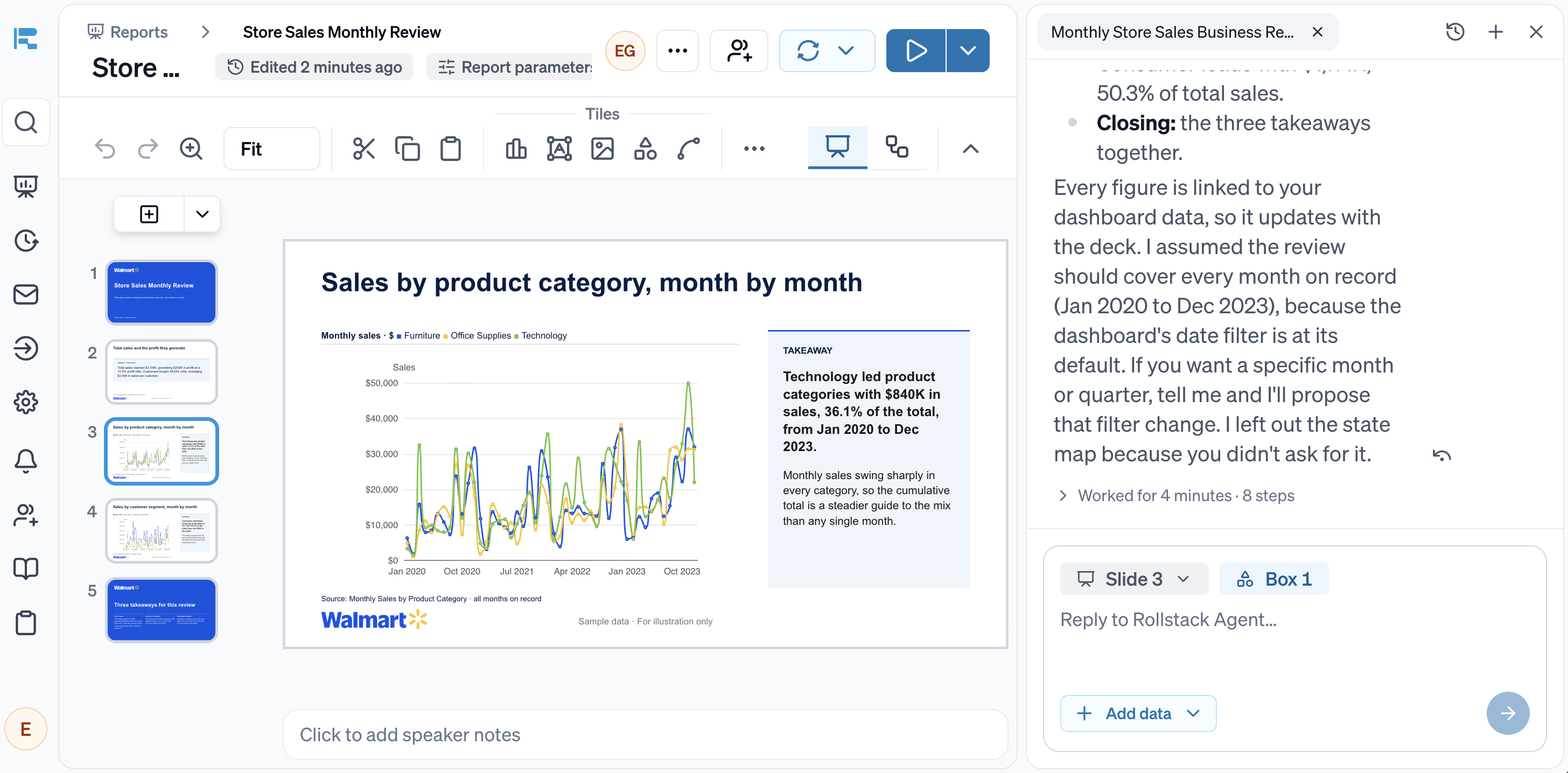
Next week's version
ChatGPT can refresh an existing deck from new data while keeping its structure, and scheduled tasks can rerun the job. Each run is the model writing the content again from new inputs, so someone reads the whole deck again. Each run can drift from the last, in the numbers and in the formatting, so the prompting starts over every cycle.
In Rollstack, next week is a refresh of the same queries. Only the numbers and charts change; your commentary, layout and slide order stay as you left them.
One template, every audience
ChatGPT builds one deck per request, so ten regions means ten requests, each reviewed on its own.
Rollstack Bursts turn one template into a version per region, sales channel, team, product line or client, each filtered to its own data. A change to the template reaches every version on the next run.
Rollstack customers already run their reporting this way:
- Equality Health changes one master template and produces about 2,000 decks a month for its 800+ practices.
- The Orchard's five analysts deliver more than 6,500 tailored reports a quarter to 10K+ clients and labels.
- CarGurus gives its account managers tailored reporting for 30K+ dealer partners.
Permissions, security and your LLM
ChatGPT Enterprise has strong security: SOC 2 Type 2, ISO 27001 and 27701, a HIPAA BAA, SAML SSO, SCIM and audit logs through its Compliance API. Its Data agent follows each user's source permissions when it queries. Once a deck is built and shared, though, everyone who opens it sees what its builder could see, and ChatGPT runs on OpenAI's models only.
Rollstack matches these, and goes further in three places that matter to regulated and data-heavy teams:
- Follows the roles and permissions in your BI tools and warehouse, including row-level security, so each version contains only its audience's data.
- Logs every update and keeps every deck as it was sent, so you can show what a stakeholder saw and when.
- Lets you choose the LLM, whether that's Claude Opus 5.5, GPT 6.1 Sol or your own Azure AI Foundry, OpenAI, Anthropic, Amazon Bedrock or Google Vertex AI account on the Enterprise plan. Rollstack's model providers don't train on your data.
Using both
Many teams use ChatGPT to explore a question and Rollstack to publish the answer. ChatGPT can connect to custom MCP servers, so it can ask Rollstack for a deck directly, and the numbers still come from your sources.
Where the differences show up: the Monday business review
Here's a common scenario: your weekly business review has 18 slides covering revenue, orders, conversion, support volume and a few regional cuts.
With ChatGPT, someone attaches the latest data, or points a scheduled task at it, and asks for the deck in the company template. Each Monday the model writes the deck again, and someone checks every number and fixes the layout before the meeting.
With Rollstack, you build the deck once from the dashboards behind it, and it refreshes at 7am every Monday. You read the takeaways, add a line of commentary and walk into the meeting. If each region, sales channel or product line wants its own cut, a Burst sends one version to each.
Who should pick which
Choose Rollstack if
- Your deck's numbers come from warehouses, BI dashboards, spreadsheets, CRMs or PDFs, and every figure has to match the source.
- You need the same deck next week, month or quarter, in the same format, with your edits kept.
- A reviewer has to trace each figure to its source before it goes out.
- It must be built in your company's PowerPoint or Google Slides template.
- You send a version to each region, sales channel, team, product line or client, each holding only the data its audience may see.
- Your company wants to choose the LLM, OpenAI included, and call Rollstack from ChatGPT through MCP.
ChatGPT may be a fit if
- You're brainstorming a narrative from notes, with little data behind it.
- You're exploring a new question and want a quick first draft to react to.
Common questions
Can ChatGPT make a PowerPoint from an Excel file?
Yes. Attach the file and ask for a deck. ChatGPT can produce a PowerPoint file, native Google Slides or a deck you edit in ChatGPT Slides. Check each number against the source before you share it.
Can ChatGPT update last month's deck with new data?
Yes. It can refresh an existing deck from new data while keeping its structure, and scheduled tasks can rerun the job. Each run writes the content again, so you review the result. Rollstack refreshes the same queries in place and keeps your edits.
Can ChatGPT use my company template?
Yes. Template Creator turns a PowerPoint or Google Slides file into a template you can share with your workspace, though OpenAI says matching "can still need manual refinement".
Does ChatGPT connect to Snowflake?
Yes. The Data agent, launched in September 2026, queries Snowflake and other warehouses and builds interactive dashboards you can refresh and share. To get those numbers into a deck, the model writes the slides. Rollstack connects decks directly to Snowflake and every other source, and refreshes them on schedule.
Can we use OpenAI models inside Rollstack?
Yes. Choose GPT 6.1 Sol, or bring your own OpenAI account on the Enterprise plan. The numbers in the deck still come from your sources, not from the model.
Can ChatGPT call Rollstack?
Yes. ChatGPT connects to custom MCP servers, so it can ask Rollstack to build, refresh or send a deck. The deck follows your template and your permissions, and every figure links to its source.
Can Rollstack send each stakeholder their own version?
Yes. Bursts create one version per region, sales channel, team, product line or client, and each stakeholder receives a personalized email with their own version, on schedule.
How we compared
We read OpenAI's deck guidance, help center, release notes and Data agent announcement on 5 November 2026. OpenAI ships often, so check its documentation for the latest. If anything here is out of date, email compare@rollstack.com and we will fix it within 5 business days.
More comparisons
Rollstack vs Claude
Read the comparisonRollstack vs Microsoft Copilot
Read the comparisonRollstack vs Gemini in Google Slides
Read the comparisonRollstack vs Gamma
Read the comparisonRollstack vs Matik
Read the comparisonRollstack vs Beautiful.ai
Read the comparisonRollstack vs UpSlide
Read the comparisonGamma alternatives
Read the comparisonRollstack vs Slideform
Read the comparisonRollstack vs Canva
Read the comparison
What our customers say
“There is not a scenario that we could have gotten the same level of throughput, no matter how many business intelligence analysts hired because of the variability in our practice network. Rollstack made it possible to do highly personalized client reporting at scale.”
 Claire Zimmerman-NicholsChief Product and Technology Officer, Equality Health
“With Rollstack, our analysts are now able to focus on building narratives. Rollstack enabled us to shift our efforts from data preparation to analyzing its implication and answering crucial ‘so what’ questions for our clients.”
 Murali CharVP of Analytics, The Orchard
“We now spend 80% of our time generating insights instead of compiling data. The quarterly business review decks we generate with Rollstack easily drive our most valuable client meetings.”
 Nader KhalilDirector of Field AM, CarGurus
Sources
- OpenAI, generate or revise a slide deck: https://learn.chatgpt.com/use-cases/generate-slide-decks
- OpenAI help center, ChatGPT for PowerPoint: https://help.openai.com/en/articles/20001242
- OpenAI help center, presentation templates: https://help.openai.com/en/articles/20001278
- OpenAI, ChatGPT release notes: https://help.openai.com/en/articles/6825453
- OpenAI, Data agent announcement: https://openai.com/index/put-data-to-work/
- OpenAI help center, custom MCP connectors: https://help.openai.com/en/articles/12584461
- OpenAI security and privacy: https://openai.com/security-and-privacy/
- OpenAI enterprise privacy: https://openai.com/enterprise-privacy/
- Equality Health customer story: https://www.rollstack.com/customers/equality-health
- The Orchard customer story: https://www.rollstack.com/customers/the-orchard
- CarGurus customer story: https://www.rollstack.com/customers/cargurus
About Rollstack.
Rollstack is the AI presentation platform for business reporting. It connects to data warehouses such as Snowflake, Databricks, BigQuery and Redshift, BI tools such as Tableau, Power BI and Looker, and spreadsheets such as Excel and Google Sheets. It also connects to CRMs such as Salesforce and HubSpot, PDFs and documents, and any other source through its API. It builds decks in your own PowerPoint or Google Slides template, links every number to its source, refreshes on a schedule, and creates one version per region, sales channel, team, product line or client. Teams build and edit decks in Rollstack, export them to PowerPoint, Google Slides or PDF, and each stakeholder gets their version in a personalized email. Rollstack is LLM-agnostic, access follows the permissions in your BI tools and warehouse, and it is SOC 2 Type II, HIPAA and GDPR compliant. Customers include SoFi, Tripadvisor, CarGurus and Octopus Energy.

Test it on your own deck
Bring the deck you rebuild most often and the data behind it. We will rebuild it in your template and refresh it live.