Rollstack vs Canva:On-brand design vs decks built from your data
Canva was built for good-looking, on-brand design: brand kits and templates, a large design library, and Canva AI to build presentations from a conversation.
Rollstack team, reviewed by Elliot Gunn Updated Nov 5, 2026
Trusted by the world's best organizations


Verdict
Canva makes on-brand presentations fast, but its numbers sit in a sheet inside each design and are refreshed by hand, so they go out of date between updates and anyone who opens the design sees all of the data.
Rollstack calculates every figure with a deterministic query (the same data always gives the same number) on your warehouse, BI dashboard or spreadsheet, traces it back to its source, and refreshes the deck in place, in your own template, with a version for every audience. Trusted by Relevate Health, The Orchard and CarGurus, Rollstack leads on 10 of the 12 comparison criteria below and matches Canva on security and API.
Where Rollstack is stronger
Calculated from your data, traced from slide to source.
Every number comes from a query on your warehouse, BI dashboard or spreadsheet, every chart traces back to its source in Lineage, and your data lands in the same format on every refresh.
Every trusted source, connected directly.
Rollstack connects directly to warehouses (Snowflake, Databricks), BI tools (Tableau, Power BI, Looker and more), spreadsheets (Excel, Google Sheets), CRMs (Salesforce CRM Analytics, or HubSpot through the Rollstack API), PDFs and documents, and any source with an API. Canva Sheets connects to a handful of apps and Snowflake, refreshed by hand.
Your own PowerPoint or Google Slides template.
Rollstack builds inside your existing master, not a Canva brand template.
Next month refreshes in one click.
The same deck refreshes on a schedule in the same format, and your edits stay.
A version for every audience.
Bursts build one deck per region, sales channel, team, product line or client from one template, each holding only the data its audience may see, and email each one to its owner.
Governance built-in for BI & LLMs.
Access follows your BI tools as well as your warehouse, Rollstack supports HIPAA, and you choose the model provider.
Works the way you do.
Integrates with agentic workflows and AI assistants like ChatGPT and Claude to build, refresh and send decks that stay tied to your data, through the Rollstack API and MCP server.




At a glance
| Criterion | Rollstack | Canva |
|---|---|---|
| Data sources | Yes: warehouses (Snowflake, Databricks, BigQuery, Redshift), BI tools (Tableau, Power BI, Looker and more), spreadsheets (Excel, Google Sheets), CRMs (Salesforce CRM Analytics, or HubSpot through the Rollstack API), PDFs and documents, and any source with an API | Partly: Canva Sheets connects to Snowflake, HubSpot, Google Analytics, Salesforce and Google Sheets on Business and Enterprise plans, refreshed by hand |
| Verified numbers | Yes: charts, tables and figures come from queries on your sources, not from the model. Each one opens in Inspect with its source, query, filters and last update. Every AI change can be reviewed before the deck goes out | Partly: charts linked to a sheet follow its data within the same design |
| Your template | Yes: builds inside your existing PowerPoint or Google Slides master | Partly: brand kits and brand templates; PowerPoint import is in beta, and charts don't come across |
| Next cycle | Yes: refreshes in place, on a schedule or in one click. Your edits stay | Partly: linked charts update within the same design; connector data is refreshed by hand, and Canva AI's scheduled tasks create new content |
| One version per audience | Yes: Bursts build a version per region (North America, EMEA, LATAM, APAC), sales channel, sales team, product line, product category, client or location, and send them on schedule | Partly: Bulk Create turns rows into one design each, on desktop |
| Personalized email delivery | Yes: each stakeholder receives a personalized email with their own version, on schedule | No: share a link or download each design |
| Your permissions | Yes: follows the roles and permissions in your BI tools and warehouse. Each version holds only its audience's data | No: anyone who can open the design sees the imported data |
| Security and audit | Yes: SOC 2 Type II, GDPR, supports HIPAA. SAML SSO and SCIM. Every update logged. On-premise BI over VPN | Yes: SOC 2 Type II and ISO 27001, with SSO, SCIM, audit logs and data residency on Enterprise |
| LLM choice | Yes: Claude Opus 5.5 or GPT 6.1 Sol, or your own Azure AI Foundry, OpenAI, Anthropic, Amazon Bedrock or Google Vertex AI account on the Enterprise plan | No: Canva's own models |
| API and MCP | Yes: build, refresh and send decks through the API, or from ChatGPT, Claude and other agents through MCP | Yes: the Connect API, and an AI connector that lets ChatGPT, Claude, Gemini and Copilot create, edit and export designs |
| Built for every team | Yes: sales, customer success, finance, business operations, RevOps, marketing, agencies and consultants, for one-off analysis and every report that repeats | Partly: visual and brand content for every team, led by marketing and design |
| Native output | Yes: work in the Rollstack platform, or deliver PowerPoint, Google Slides and PDF files, plus Word and Google Docs, with native, editable charts and tables | Partly: designs live in Canva, with PowerPoint and PDF export |
| Best at | Decks built from business data, one-off or every week, month and quarter | On-brand marketing, campaign and visual decks |
Canva details checked on 5 November 2026. Sources are listed at the end of this page.
The comparison in depth
Where the numbers come from
In Canva, data lives in Canva Sheets. On Business and Enterprise plans, it can bring in data from Snowflake, HubSpot, Google Analytics, Salesforce and Google Sheets, and charts in the same design follow the sheet. Data from connected apps is refreshed by hand, and BI tools such as Tableau, Power BI and Looker aren't among its connectors.
Rollstack connects directly to every source, BI dashboards included. The Tableau view or Power BI visual your analysts certified lands on the slide with its filters, and every source in a deck refreshes together.
Checking the numbers
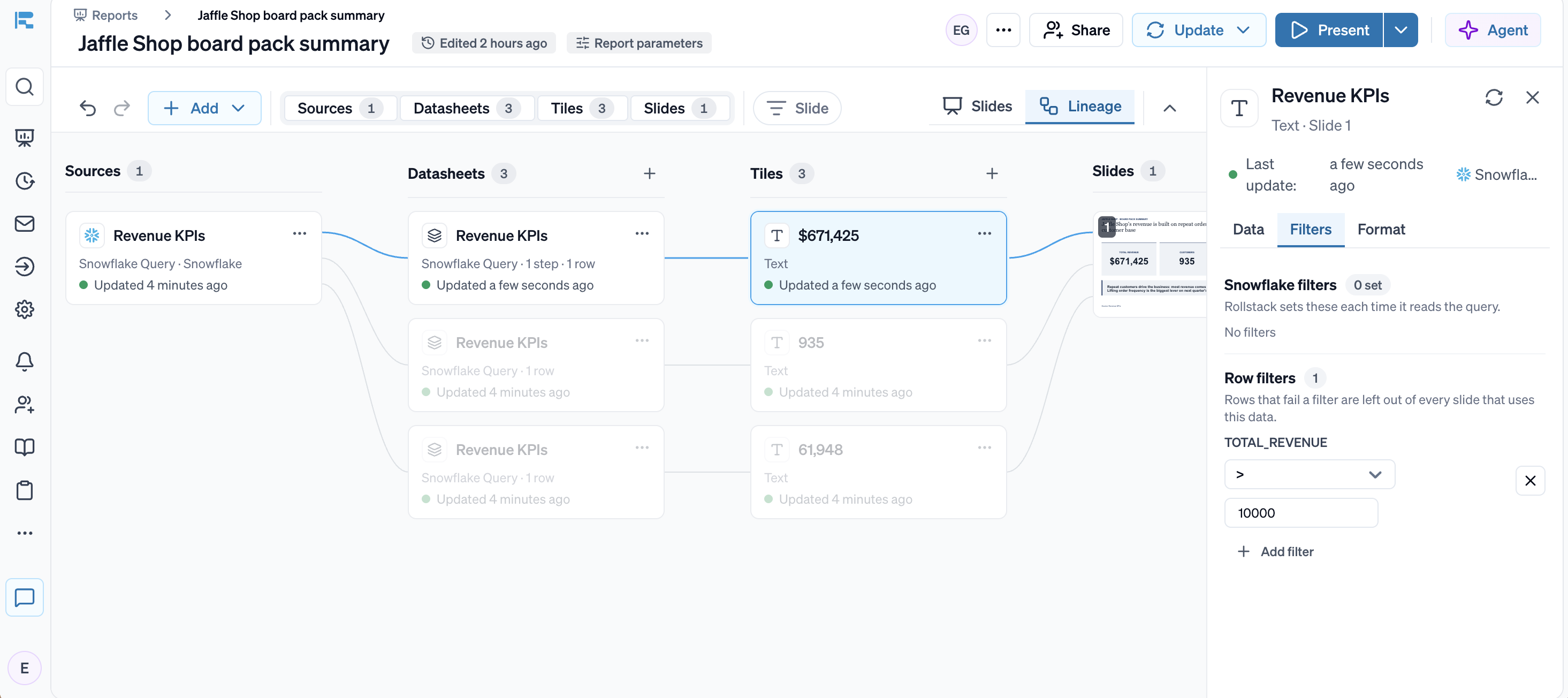
A Canva chart follows the sheet it's linked to, but nothing on the slide shows a reviewer where a figure came from or which filters were applied.
In Rollstack, every figure on a slide can be traced back to the raw data and each transformation applied to it. Reviewers can check numbers without rebuilding anything.
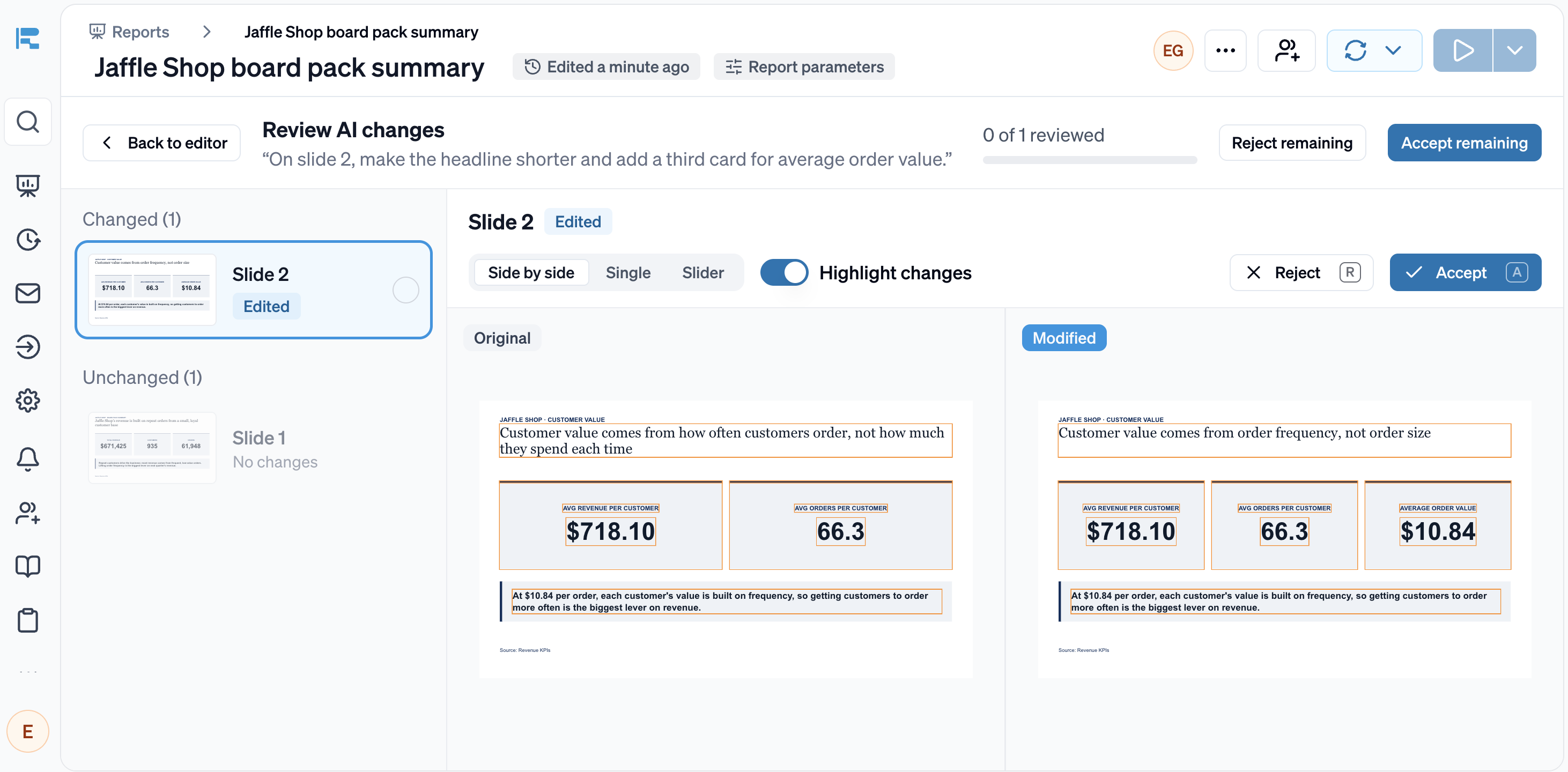
When Rollstack's AI makes changes, you can review them before the deck goes out: the original and the edited slide side by side, with all changes highlighted.
Your template, not a brand kit
Canva's brand kits and brand templates keep every design on brand, and Canva AI applies your brand when it builds a deck. Your existing PowerPoint master is another matter: PowerPoint import is in beta, and charts don't come across.
Rollstack keeps your template as it is. Upload your PowerPoint file, or import it from Google Slides or OneDrive, and it becomes a reusable template with your masters, placeholders, fonts and footer intact. Pick a dashboard, table or sheet as the source, and Rollstack builds the deck in that template, with native charts connected directly to your data.
Next month
In Canva, charts linked to a sheet update within the same design, but data from connected apps has to be refreshed by hand in each design. Canva AI can run scheduled tasks, though they create new content rather than refresh the numbers in an existing deck.
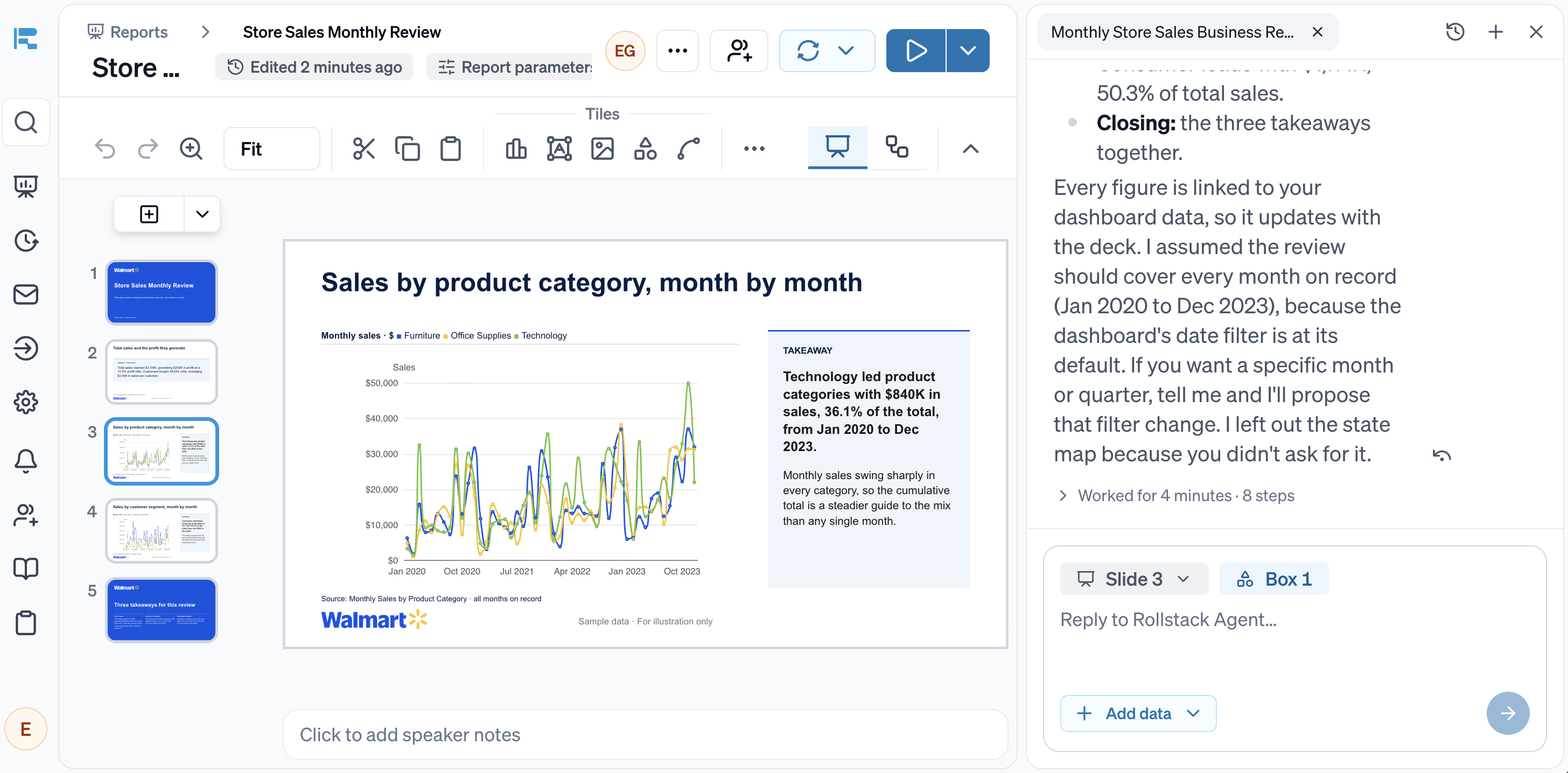
In Rollstack, next month is a refresh of the same deck. Only the numbers and charts change; your commentary, layout and slide order stay as you left them.
One template, every audience
Canva's Bulk Create turns rows of data into one design each, which works for name badges and social posts. It doesn't filter each design to its audience's data, and each one is shared by hand.
Rollstack Bursts turn one template into a version per region, sales channel, team, product line or client, each filtered to its own data and emailed to its owner. A change to the template reaches every version on the next run.
Rollstack customers already run their reporting this way:
- Relevate Health produces 60 personalized client decks in under four hours.
- The Orchard's five analysts deliver more than 6,500 tailored reports a quarter to 10K+ clients and labels.
- CarGurus gives its account managers tailored reporting for 30K+ dealer partners.
Permissions, security and your LLM
Canva is SOC 2 Type II and ISO 27001 certified, with SSO, SCIM, audit logs and data residency on Enterprise. Inside a design, though, anyone who can open it sees all the imported data, whatever their access to the source, and Canva's AI runs on its own models.
Rollstack matches these, and goes further in three places that matter to regulated and data-heavy teams:
- Follows the roles and permissions in your BI tools and warehouse, including row-level security, so each version contains only its audience's data.
- Supports HIPAA and connects to on-premise BI over VPN.
- Lets you choose the LLM, whether that's Claude Opus 5.5, GPT 6.1 Sol or your own Azure AI Foundry, OpenAI, Anthropic, Amazon Bedrock or Google Vertex AI account on the Enterprise plan. Rollstack's model providers don't train on your data.
Using both
Many teams keep Canva for campaign, brand and social content, and run their reporting decks in Rollstack. AI assistants such as ChatGPT and Claude can work with both through MCP.
Where the differences show up: monthly reports for 30 clients
Here's a common scenario: an agency sends 30 clients a monthly performance report. The numbers come from HubSpot, Google Analytics and a Looker dashboard, and each account manager adds a few lines of commentary.
With Canva, you can design a polished report template, bring HubSpot and Google Analytics data into Canva Sheets and use Bulk Create to make 30 designs. Looker isn't connected, each month the connector data is refreshed by hand, and every design holds whatever data was imported into it.
With Rollstack, you build the template once against the Looker dashboard and your other sources, add a client filter and schedule the run. Next month, the same 30 decks refresh in place, each holding only that client's data, and every account manager's commentary is still there.
Who should pick which
Choose Rollstack if
- Your deck's numbers come from warehouses, BI dashboards, spreadsheets, CRMs or PDFs, and every figure has to match the source.
- You need the same deck next week, month or quarter, in the same format, with your edits kept.
- It must be built in your company's or your client's PowerPoint or Google Slides template.
- You send a version to each client, region, sales channel, team or product line, each holding only the data its audience may see.
- Your security team needs permissions that follow your data systems, and a say in which LLM reads your data.
- Your team wants to work agentically: Rollstack is integrated with AI assistants through an open API and MCP server.
Canva may be a fit if
- Your decks are brand, campaign or event content, where design matters more than data.
- You want one tool for presentations, social posts, documents and video.
Common questions
Can Canva connect to my data?
Yes, through Canva Sheets on Business and Enterprise plans: Snowflake, HubSpot, Google Analytics, Salesforce and Google Sheets. Data from connected apps is refreshed by hand. Rollstack connects directly to those sources and to BI tools such as Tableau, Power BI and Looker, and refreshes every chart in a deck together on a schedule.
Do Canva charts update automatically?
Charts linked to a sheet update within the same design. Data from connected apps needs a manual refresh, and nothing refreshes a deck on a schedule. Rollstack refreshes the same deck in place and keeps your edits.
Can I use my PowerPoint template in Canva?
Canva can import PowerPoint files in beta, but charts don't come across, and its brand templates replace your master. Rollstack builds directly inside your existing PowerPoint or Google Slides master.
Does Canva have an API or MCP server?
Yes. Canva's Connect API and its AI connector let ChatGPT, Claude, Gemini and Copilot create, edit and export designs. Rollstack's API and MCP server build, refresh and send decks that stay tied to your data.
Can we use both?
Yes. Many teams use Canva for brand and campaign content and Rollstack for reporting decks built from data.
Can Rollstack send each stakeholder their own version?
Yes. Bursts create one version per region, sales channel, team, product line or client, and each stakeholder receives a personalized email with their own version, on schedule.
How we compared
We read Canva's website, help center, developer documentation, security page and newsroom on 5 November 2026. If anything here is out of date, email compare@rollstack.com and we will fix it within 5 business days.
More comparisons
Rollstack vs Beautiful.ai
Read the comparisonRollstack vs Gamma
Read the comparisonGamma alternatives for business decks
Read the comparisonRollstack vs ChatGPT
Read the comparisonRollstack vs Claude
Read the comparisonRollstack vs Copilot
Read the comparisonRollstack vs Gemini
Read the comparisonRollstack vs Matik
Read the comparisonRollstack vs UpSlide
Read the comparisonRollstack vs Slideform
Read the comparison
What our customers say
“Rollstack has been the perfect solution for us to exponentially improve our report efficiency. As our reporting needs have grown, the need for quicker turnarounds has been critical to letting our team focus on providing actionable insights to our clients instead of being PowerPoint jockeys.”
 Scott ClairVP Decision Science and Analytics, Relevate Health
“With Rollstack, our analysts are now able to focus on building narratives. Rollstack enabled us to shift our efforts from data preparation to analyzing its implication and answering crucial ‘so what’ questions for our clients.”
 Murali CharVP of Analytics, The Orchard
“We now spend 80% of our time generating insights instead of compiling data. The quarterly business review decks we generate with Rollstack easily drive our most valuable client meetings.”
 Nader KhalilDirector of Field AM, CarGurus
Sources
- Canva Sheets: https://www.canva.com/sheets/
- Canva help center, data connectors: https://www.canva.com/help/data-connectors/
- Canva help center, importing from Snowflake: https://www.canva.com/help/import-snowflake/
- Canva help center, importing data into charts: https://www.canva.com/help/import-to-charts/
- Canva help center, PowerPoint import: https://www.canva.com/help/powerpoint-import/
- Canva help center, AI connector: https://www.canva.com/help/mcp-agent-setup/
- Canva developers, MCP: https://www.canva.dev/docs/mcp/verify-integration/
- Canva security: https://www.canva.com/security/
- Canva for IT: https://www.canva.com/solutions/it/
- Canva Create 2026 announcement: https://www.canva.com/newsroom/news/canva-create-2026-ai/
- Relevate Health customer story: https://www.rollstack.com/customers/relevate-health
- The Orchard customer story: https://www.rollstack.com/customers/the-orchard
- CarGurus customer story: https://www.rollstack.com/customers/cargurus
About Rollstack.
Rollstack is the AI presentation platform for business reporting. It connects to data warehouses such as Snowflake, Databricks, BigQuery and Redshift, BI tools such as Tableau, Power BI and Looker, and spreadsheets such as Excel and Google Sheets. It also connects to CRMs such as Salesforce and HubSpot, PDFs and documents, and any other source through its API. It builds decks in your own PowerPoint or Google Slides template, links every number to its source, refreshes on a schedule, and creates one version per region, sales channel, team, product line or client. Teams build and edit decks in Rollstack, export them to PowerPoint, Google Slides or PDF, and each stakeholder gets their version in a personalized email. Rollstack is LLM-agnostic, access follows the permissions in your BI tools and warehouse, and it is SOC 2 Type II, HIPAA and GDPR compliant. Customers include SoFi, Tripadvisor, CarGurus and Octopus Energy.

Test it on your own deck
Bring a client report you rebuild every month and the data behind it. We will rebuild it in your template and refresh it live.