
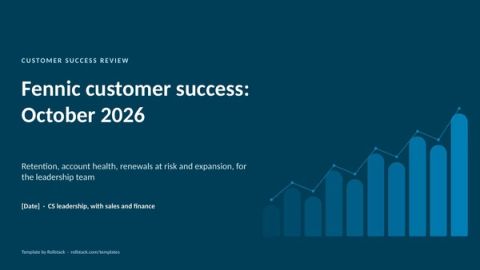
Customer success report template: retention, health and renewals in one review
Free to use and adapt for your own work.
Slide 1 of 12
Rollstack team, reviewed by Nabil Jallouli Updated Nov 11, 2026
A customer success report shows the leadership team what is happening across the customer base. How much revenue did you keep and grow, which accounts are healthy, which renewals are at risk, and what will the CS team do about it? This template gives you 9 slides for that monthly review. Customer-facing reviews use the QBR and EBR templates instead.
The 9 slides
| # | Slide | What goes on it | Data you need |
|---|---|---|---|
| 1 | Summary | Net and gross revenue retention, ARR renewing in the next 90 days, and one line on the month | Billing, CS platform |
| 2 | Retention trend | Net and gross retention by quarter against target, with expansion and churn | Billing |
| 3 | Account health | Share of ARR that is healthy, on watch or at risk, by segment | CS platform |
| 4 | Renewals in the next 90 days | The largest renewals with health, risk, owner and forecast | CS platform, CRM |
| 5 | Churn | Churned ARR by reason, split into what you can and cannot influence | CS platform, billing |
| 6 | Expansion | Expansion pipeline for next quarter by type, and how much CS sources | CRM |
| 7 | Onboarding | Time to first value by quarter, and onboarding finished on time | Product analytics, CS platform |
| 8 | Coverage | Accounts and ARR per CSM against plan, by segment | CS platform, HR system |
| 9 | Priorities | Actions with owners, dates and the expected effect | Written by the CS leader |
| A | Appendix | Definitions of retention, health score, first value and CS-sourced expansion | CS operations |
The file has 12 pages: these 9 slides plus a cover, an appendix and a how-to slide you delete before presenting.
Rules for a CS report leadership acts on
Report retention the way finance does. Net and gross revenue retention should match the board deck to the decimal. Agree the definitions with finance once and use the same source.
Weight health by revenue. A hundred small healthy accounts can hide one large account at risk. Show health as a share of ARR, by segment.
Name the renewals. Leaders act on accounts, not averages. The renewals slide lists the largest ones with a risk in a few words and an owner.
Separate churn you can influence. Acquisitions and budget cuts happen. Low adoption, product gaps and competitive losses are where CS and product can act, so show them apart.
Treat coverage as a leading indicator. Overloaded books of business show up in health scores a quarter later. Report accounts per CSM against plan every month.
Mistakes we see most often
- Retention numbers that differ between the CS review and the board deck.
- Health scores averaged by account count instead of weighted by revenue.
- A list of at-risk accounts with no save plan or owner.
- Expansion left to the sales review, so net retention looks like luck.
- A report that takes the CS operations team two days a month to build.
Run it every month without rebuilding it
- Open this template in Rollstack and connect your billing system, CS platform, CRM and product analytics, directly or through your warehouse or BI tool. Rollstack also works with spreadsheets, documents and any source with an API.
- Map each chart and table to its source once.
- Schedule the refresh for the morning of the review, so the renewals list is current.
- Create one version per CS manager, each with their own book of accounts.
- Use the same connections to give every customer a QBR deck with their own numbers.
ChannelSight cut the time it spends preparing QBRs by 75% with Rollstack.
Fill this template with your data Get a demo
What our customers say
“What I love about Rollstack is how it makes it so easy to gather analytics and create client decks. It saves me time and helps me put together everything I need quickly, which my clients really appreciate.”
 Claudia BergqvistCustomer Success Manager, Swapcard
“We now spend 80% of our time generating insights instead of compiling data. The quarterly business review decks we generate with Rollstack easily drive our most valuable client meetings.”
 Nader KhalilDirector of Field AM, CarGurus
“Rollstack significantly enhances our reporting capabilities, delivering an instant reduction in our report preparation time after just one month of usage. We received overwhelming positive adoption and feedback from our teams, while also gaining increased confidence in expanding our report use cases for clients.”
 Thu PhamSenior Solution Analyst, Product Coaching, ChannelSight
Common questions
What should a customer success report include?
Net and gross revenue retention, account health by segment, upcoming renewals and their risks, churn reasons, expansion pipeline, onboarding speed, team coverage and the priorities for next month.
What is the difference between net and gross revenue retention?
Net revenue retention includes expansion from existing customers; gross revenue retention excludes it and is capped at 100%. Net shows growth from the base; gross shows how much of the base you kept.
How should account health be reported?
As a share of ARR in each health band, by segment, with the signals that move the score written down. Weighting by revenue keeps large accounts visible.
How often should CS leaders review the customer base?
Monthly for the full review, with a weekly look at renewals in the next 90 days.
How is this different from a QBR?
A QBR is a meeting with one customer about their results. A customer success report is an internal review of all customers for the leadership team.
Get the template
Free to use and adapt for your own work.
Native PowerPoint charts and tables, sample data from a fictional company, and speaker notes on every slide. Using Google Slides? Upload the file to Drive and open it with Google Slides; charts arrive as pictures, everything else stays editable, so it's best in PowerPoint.
Discover more templates
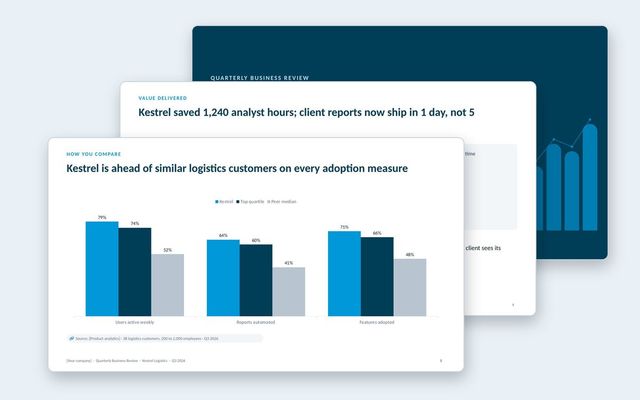 Quarterly business review (QBR)A customer-facing QBR built around goals, value delivered, adoption, peer benchmarks and the plan for next quarter.See the template
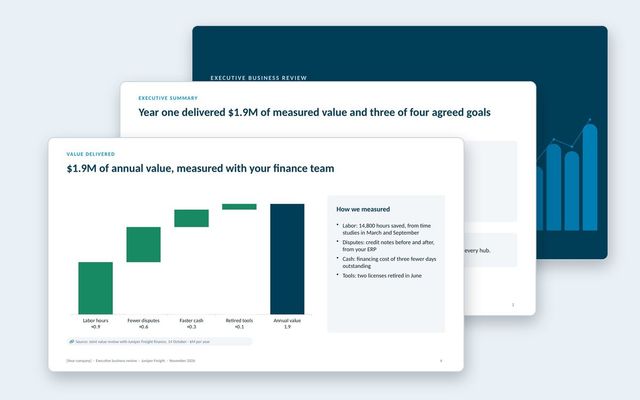 Executive business review (EBR)A renewal-stage review for the economic buyer: success plan, measured value, adoption, feedback, year-two goals and the proposal.See the template
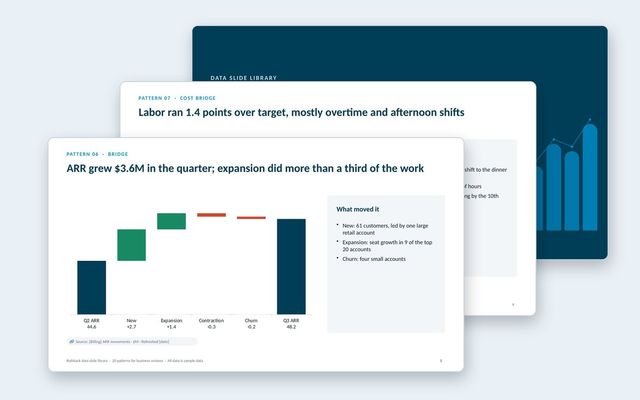 Data slide libraryTwenty reusable data slides: summaries, scorecards, KPI cards, trends, bridges, rankings, benchmarks, variances, options, roadmaps, decisions and risks.See the template
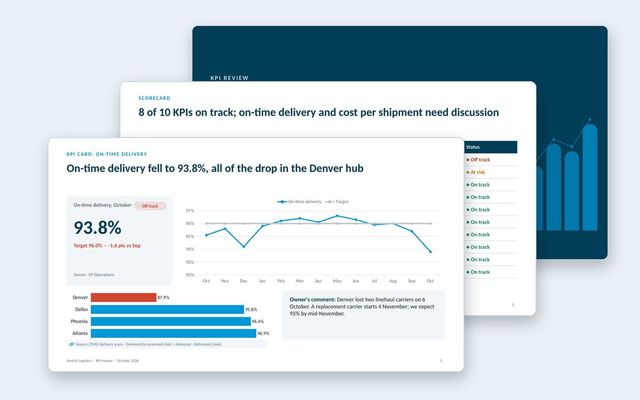 KPI presentationA KPI review built on three slide types: the scorecard, a KPI card for each KPI that needs discussion, and the exceptions list.See the template
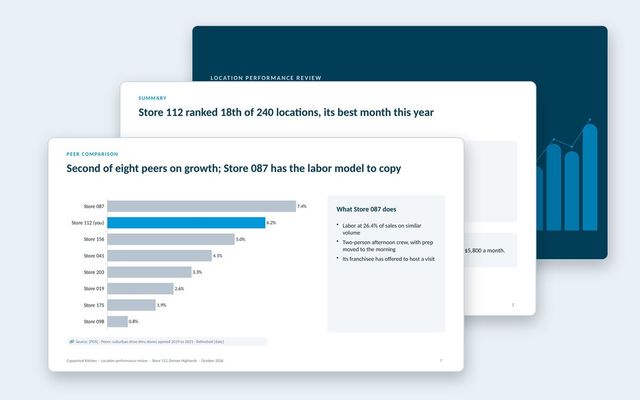 Location performance reviewOne deck per location: scorecard against target and network, sales trend, mix, labor bridge, peer comparison, guest feedback and actions.See the template
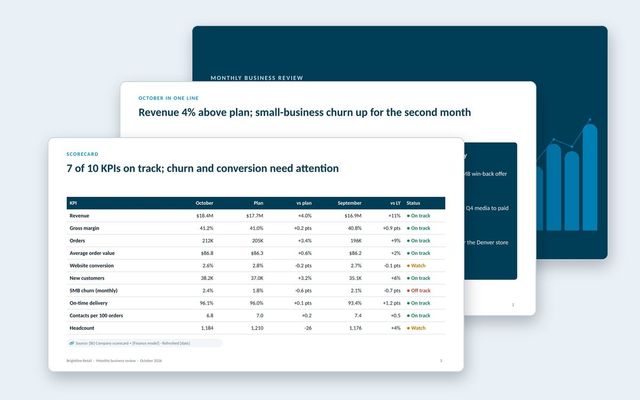 Monthly business review (MBR)A leadership MBR: the month in one line, KPI scorecard, revenue and customers, leading indicators, operations, one focus topic and decisions.See the template
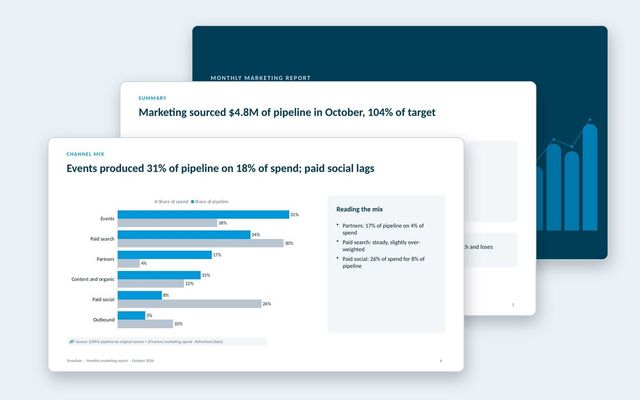 Monthly marketing reportA pipeline-first marketing report: scorecard, funnel, pipeline trend, channel mix and efficiency, AI search, programs, budget and the plan.See the template
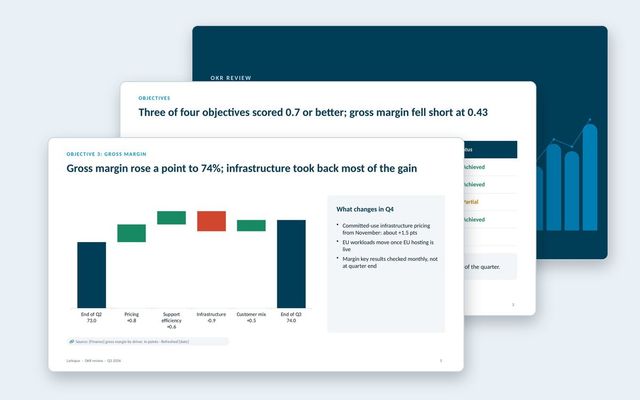 OKR reviewA quarterly OKR review: scores by objective and key result, a deep dive on the miss, lessons, draft OKRs for next quarter and decisions.See the template
About Rollstack.
Rollstack is the AI presentation platform for business reporting. It connects to data warehouses such as Snowflake, Databricks, BigQuery and Redshift, BI tools such as Tableau, Power BI and Looker, and spreadsheets such as Excel and Google Sheets. It also connects to CRMs such as Salesforce and HubSpot, PDFs and documents, and any other source through its API. It builds decks in your own PowerPoint or Google Slides template, links every number to its source, refreshes on a schedule, and creates one version per region, sales channel, team, product line or client. Teams build and edit decks in Rollstack, export them to PowerPoint, Google Slides or PDF, and each stakeholder gets their version in a personalized email. Rollstack is LLM-agnostic, access follows the permissions in your BI tools and warehouse, and it is SOC 2 Type II, HIPAA and GDPR compliant. Customers include SoFi, Tripadvisor, CarGurus and Octopus Energy.
Customer success report template: retention, health and renewals in one review · 12 pages
Download