


Last updated: October 2026
An investor presentation, sometimes called an investment presentation, is the deck a company puts in front of the people who fund it. Public companies give one every quarter. Startups build one for every funding round. Private companies with outside investors send a version of it to their board and shareholders on a set schedule.
Most advice treats the deck as a one-time pitch and spends its time on design. Design matters. But investors forgive a plain slide far faster than a number that doesn't match the filing, or last quarter's deck. The investor presentations that hold up are built like recurring reports: a stable structure, definitions that don't drift, figures that tie out to the source. The story is the part you write fresh each time.
This guide covers what an investor presentation is, the main types, what to include slide by slide, how to craft an effective one, real slides from NVIDIA, Portland General Electric, Snowflake and Coca-Cola, and the mistakes that cost credibility. It starts from public company decks, and most of it applies just as well to private companies and startups that report to investors.
TL;DR
- What it is. An investor presentation is a slide deck a company uses to explain its results, strategy and outlook to current or potential investors.
- The type sets the structure. An earnings deck, an investor day deck and a startup pitch deck share a backbone but answer different questions.
- Lead with the thesis. Give investors the reasons to own the stock or fund the round early, then prove each one with data.
- Accuracy beats polish. Every figure should tie out to the filing or the board-approved financials, with the same definitions every period.
- Automate the numbers, write the story. Investor decks repeat every quarter. Tools like Rollstack link the charts and tables to your governed data, so each refresh comes out accurate and in the same format and your team's time goes to the narrative.
What is an investor presentation?
An investor presentation is a slide deck a company uses to explain its business to current and potential investors. It typically covers the company's financial performance, strategic initiatives, market opportunities and future outlook. For publicly traded companies, these presentations are often used during earnings calls, annual general meetings, investor conferences and roadshows. Private companies and startups use them to attract venture capital, secure funding rounds and communicate growth potential.
The deck rarely travels alone. A public company posts it to its investor relations site with the earnings release and the call. A founder sends it ahead of a meeting and talks through it live. Either way, the slides get read without you in the room, so each one has to make sense on its own.
Investor presentation vs. pitch deck
A pitch deck is one kind of investor presentation: the one a startup uses to raise money from new investors. "Investor presentation" is the wider term. It also covers the decks a company presents to the investors it already has, like the quarterly earnings deck, the investor day deck or the monthly investor update.
The practical difference is the job. A pitch deck has to earn a second meeting. An earnings deck has to explain what happened this quarter, consistently with every quarter before it.
Types of investor presentations
| Type | Who presents it | When | What sets it apart |
|---|---|---|---|
| Earnings presentation | Public companies | Every quarter, with the earnings release and call | Results against the prior quarter and prior year, guidance, non-GAAP reconciliations |
| Corporate investor presentation | Public companies | Refreshed each quarter, used at conferences and investor meetings | The standing story: investment thesis, strategy, latest financials |
| Investor day presentation | Public companies | Occasionally, often years apart | Multi-year strategy and financial targets, several presenters |
| IPO roadshow presentation | Companies going public | Before the IPO | The full company story for a new set of investors, built with bankers and counsel |
| Pitch deck | Startups and private companies raising money | Each funding round | Problem, solution, market, traction, team and the ask |
| Investor update or board deck | Private companies with outside investors | Monthly or quarterly | Results against plan, cash and runway, decisions needed |
Three of these six come around on a fixed schedule. That's worth keeping in mind before you build anything: the deck you make this quarter is the template for the next one.
What format are investor presentations?
Most investor presentations are built in a slide tool and shared as a PDF.
- PowerPoint. Flexible, works with most corporate templates, and easy to pass between investor relations, finance and legal for review.
- Google Slides. Common at startups and private companies, where several people edit the same deck at once.
- Keynote. Used by some founders on a Mac, then exported to PDF or PowerPoint before it goes out.
- PDF. How most decks are distributed. A PDF looks the same on every device and can't be edited by accident. Public companies post it on their investor relations site, and many US-listed companies also furnish it to the SEC as an exhibit to a Form 8-K.
If you present live, send the PDF afterwards. Investors forward decks to colleagues and analysts, and the PDF is the version that gets read.
Key elements of an investor presentation, slide by slide
There's no single required structure, but the order below covers what to include and what investors look for. Treat it as a template: keep the sections that apply to you and cut the rest.
Public company investor presentation structure
- Cover and safe harbor statement. Company name, event and date, followed by the forward-looking statements disclaimer and a note on non-GAAP measures.
- Investment thesis or highlights. Three to six reasons to own the stock. Every other slide should support one of them.
- Company overview. What you sell, to whom, and at what scale: revenue, customers, employees, footprint.
- Market opportunity. Market size and growth, with sources on the slide.
- Strategy and priorities. What you're doing next and the measures that will show it's working.
- Financial performance. Revenue, margins, earnings per share and cash flow, compared with the prior quarter and the prior year.
- Segment and operating KPIs. The metrics that explain the financials, defined the same way every period.
- Capital allocation. Investment, dividends, buybacks and debt.
- Outlook or guidance. Ranges for the next quarter or the full year, and what drives them.
- Appendix. Non-GAAP reconciliations, metric definitions and the detailed tables you'd rather not put on the main slides.
Startup pitch deck structure
Sequoia's guide to writing a business plan is still the outline most pitch decks follow:
- Company purpose. Your company in one declarative sentence.
- Problem. The customer's pain and how they handle it today.
- Solution. Why your product makes their life better, with use cases.
- Why now. What changed that makes this possible now.
- Market potential. Who the customer is and how big the market is.
- Competition and alternatives. Direct and indirect competitors, and why you win.
- Business model. How you make money and how that scales.
- Team. The founders and key hires, and why they're the ones to build this.
- Financials. Traction to date: revenue, growth, retention, burn and runway.
- Vision. What the company looks like in five years if it works.
Add one slide Sequoia's list leaves implicit: the ask. How much you're raising, what you'll spend it on and which milestones it buys.
Investor updates and board decks
Once investors are on board, the format gets shorter and more repetitive, on purpose. A good monthly or quarterly update covers headline metrics against plan, what went well, what didn't, cash and runway, and the decisions or help you need. Keep the layout identical every period. Investors compare this update with the last one, and a familiar layout makes the changes easy to spot. Our guide to executive reporting goes deeper on board-level reporting.
How long should an investor presentation be?
For a pitch deck, 10 to 15 slides is the usual range. Guy Kawasaki's 10/20/30 rule puts it at ten slides, twenty minutes and no font smaller than 30 points. The first slides carry the most weight: DocSend's pitch deck research reports that investors spend less than three minutes reviewing a deck.
Public company decks run longer because they carry more detail. Keep the main section tight and move tables, reconciliations and definitions to the appendix.
Best practices for investor presentations
Branding
Your presentation should look like your company. Use your colors, fonts and logo consistently, and pick one accent color to mark what matters most. In this example, NVIDIA sticks with its brand colors and uses its green for one thing on the chart: the current quarter. Everything else is gray, so the eye goes to the result first.
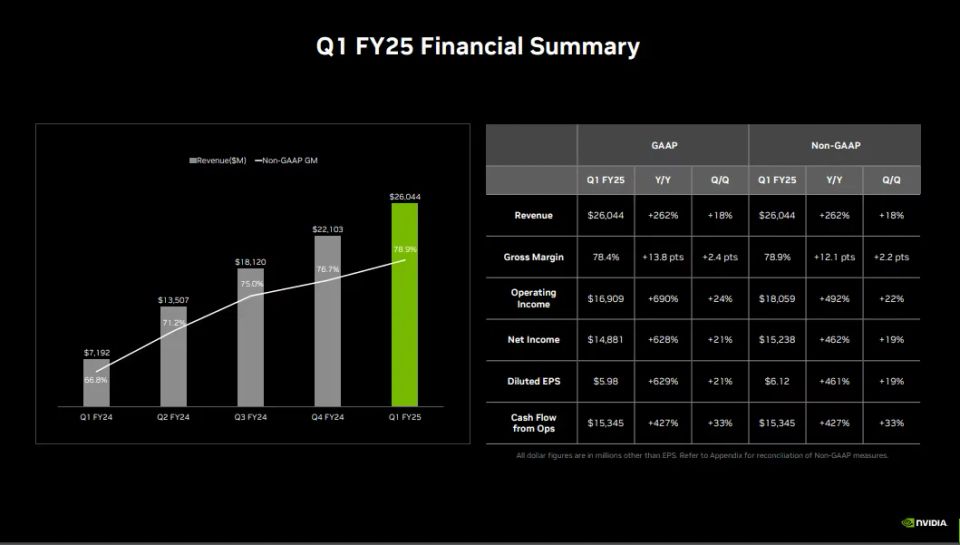
NVIDIA's Q1 FY25 financial summary. Brand green marks the current quarter, GAAP and non-GAAP results sit side by side with year-over-year and quarter-over-quarter change, and a footnote points to the reconciliation in the appendix. Source: NVIDIA Q1 FY25 results.
Accuracy
Every number in the deck should tie out to its source: the 10-Q or 10-K for a public company, the board-approved financials for a private one. Pick one source of truth per metric. Keep definitions identical from quarter to quarter, and use the same rounding and units on every slide.
If you show non-GAAP measures, US public companies also have to present the most comparable GAAP measure and a reconciliation between the two under Regulation G. Before the deck goes out, have someone who didn't build it check the numbers against the source. Analysts will do it anyway.
Storytelling
Investors remember a thesis better than a list of facts. Open with the reasons someone should invest, then use the rest of the deck to prove each one with data. For a startup, the arc runs from problem to solution, market, traction and the ask. For a public company, it's thesis, performance, strategy and outlook.
Portland General Electric sums up its case on one "Investment thesis" slide.
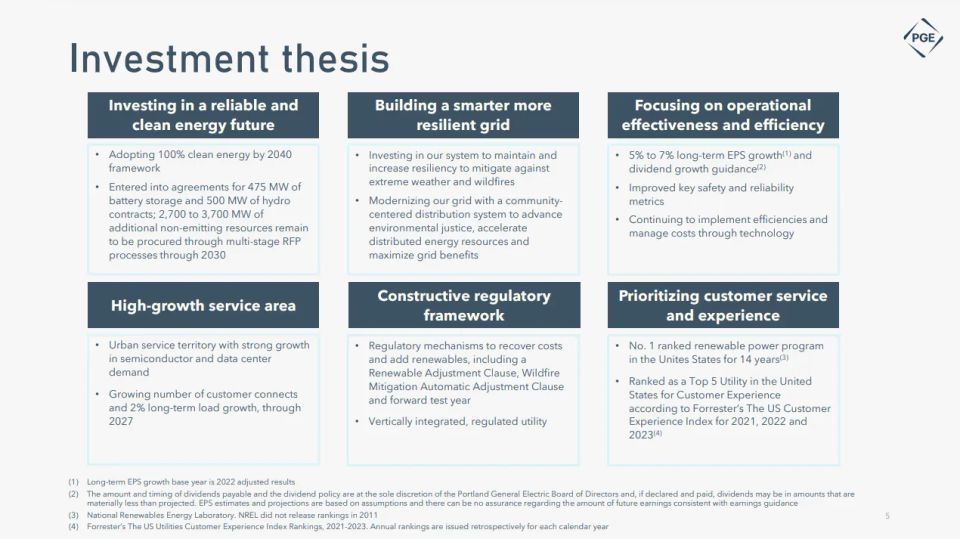
Portland General Electric's "Investment thesis" slide. Six claims, each with a short heading, and a footnote behind every growth figure and ranking. Source: PGE investor relations.
Automate
Most investor presentations aren't one-offs. A public company rebuilds its earnings deck every quarter on the same skeleton. A private company sends its board and investors the same pack every quarter, sometimes every month. The story changes. The structure and most of the charts don't.
That makes the data the part worth automating. When the charts, tables and KPI figures in the deck are linked to their source, whether that's your BI tool, your data warehouse or finance's spreadsheets, a refresh updates every figure in the same format, and each number traces back to the query or dashboard it came from. Your team's hours go to the narrative and the Q&A prep instead of copy-paste. Our guide to financial reporting automation walks through the setup end to end.
Rollstack does this for finance and strategy teams working in PowerPoint and Google Slides. It connects to tools like Tableau, Power BI, Looker, Omni, Snowflake, Excel and Google Sheets, and refreshes the deck on a schedule or with one click. Cribl's Strategy & Operations team uses it for its quarterly board data pack, 80 to 100 slides that investors pass to their analysts to check line by line. Pulling that deck together used to take about three days of copying charts and metrics from Omni into Google Slides. Now one person refreshes more than 100 visuals in 10 to 15 minutes, and the team has delivered three straight quarters of board decks with zero data errors. Read the Cribl story.
Design
A clean design makes the numbers easier to read. Match the chart to the comparison: bars for periods, lines for trends, tables when people need exact figures. Label axes and units, and keep slides uncluttered so each chart has room. Long decks also need navigation, so readers always know which section they're in. Snowflake runs a color-coded guide across the top of the slides in the Product Delivery section of its investor presentation.
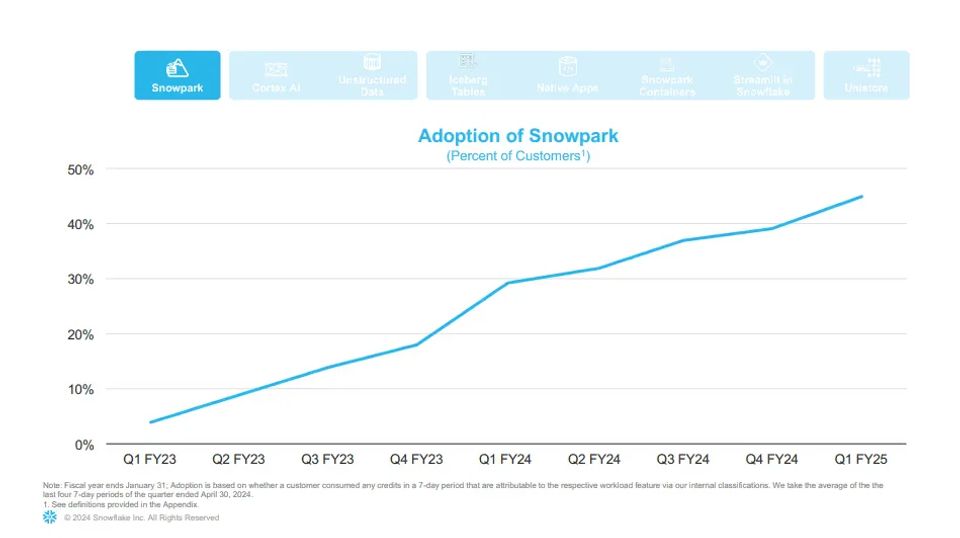
Snowflake highlights the current product, Snowpark, in a row of tabs across the top, and a footnote under the chart defines exactly how adoption is measured. Source: Snowflake investor relations.
For more on layout, type and charts, see our guide to high-quality PowerPoint presentations.
Clarity
Give each slide one message and a headline that states it. Cut any words that repeat what the chart already shows, and avoid jargon your audience would have to look up. For Coca-Cola, visualizations tell the story, not text on slides.
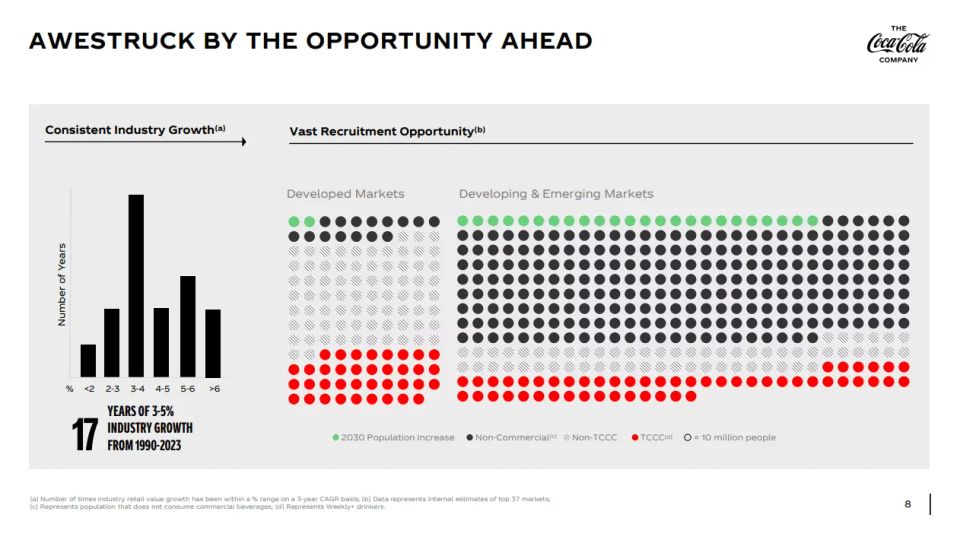
Coca-Cola's slide has two charts and one takeaway in large type: 17 years of 3-5% industry growth from 1990 to 2023. Source: The Coca-Cola Company investor relations.
Q&A preparation
Write down the ten questions you least want to hear and answer each one. Public companies can read the transcripts of their last few earnings calls, and their peers' calls, to see what analysts keep asking. Put backup slides for the likely questions in the appendix: segment detail, customer cohorts, cost breakdowns.
If you can't answer a question with confidence, say you'll follow up, and do. Public companies have one more rule to keep in mind: under Regulation FD, material information shared privately with investors has to be made public too.
Practice
Rehearse out loud, with a timer, in front of someone who will interrupt you. Time each section, not only the total, so you know what to cut if the meeting starts late. Everyone who presents should know the numbers on the slides they don't present, because questions won't arrive in order.
Common investor presentation mistakes
- Numbers that don't tie out. Revenue on one slide doesn't match the 10-Q, or a restated figure shows up without a note. The Q&A turns into a conversation about your controls instead of your strategy.
- Quietly changing a definition. If "active customers" means something new this year, say so on the slide and footnote the old basis.
- Non-GAAP figures without the bridge. Show the comparable GAAP measure and point to the reconciliation, as NVIDIA does above.
- Projections without assumptions. A steep forecast with no stated drivers invites the wrong questions. Show the few assumptions that move the number.
- Slides written as a script. If the slide holds every word you plan to say, investors read ahead and stop listening. Move the detail to the appendix or a leave-behind.
- Burying the thesis or the ask. Investors should know why to invest by the third slide.
- Stale charts. A chart left over from last quarter, with the old date range still on the axis, is one of the most common errors in a recurring deck. It's also the easiest one to prevent when charts refresh from the source.
- No disclaimer. Public companies rely on the safe harbor for forward-looking statements, which requires meaningful cautionary language alongside projections.
Where to find investor presentation examples
- Investor relations sites. Almost every public company has an investor relations section with a page called something like "Events & presentations" or "Financial information." Earnings decks, investor day decks and conference presentations are posted there, usually as PDFs. All four examples above came from decks like these.
- SEC EDGAR. Many US-listed companies furnish investor decks as an exhibit to a Form 8-K. Search EDGAR for a company name and "investor presentation."
- Pitch deck outlines from investors. Sequoia's outline above and Guy Kawasaki's 10/20/30 rule are good starting points for a startup deck.
When you study an example, look past the design. Note what the company puts on slide two, how it defines its metrics, and where it sends the detail.
Final thoughts on investor presentations
A strong investor presentation does two jobs. It tells a clear story about why the company is worth owning, and it backs every part of that story with numbers that hold up when someone checks them. Get the structure right once, keep definitions stable, and let the data refresh from the source. Then the work each quarter goes into the narrative, which is the part investors actually came for.
Rebuilding the same investor or board deck every quarter? Rollstack connects your deck to your BI tool and finance data, so every chart and figure refreshes in place, in your template, with each number traceable to its source. See it in action →
FAQ
What is an investor presentation?
An investor presentation is a slide deck a company uses to explain its results, strategy and outlook to current or potential investors. Public companies use them for earnings calls, investor conferences, investor days and roadshows. Startups and private companies use them to raise funding and to update the investors they already have.
What should an investor presentation include?
A public company deck usually includes a safe harbor statement, the investment thesis, a company overview, the market opportunity, strategy, financial performance, operating KPIs, capital allocation, outlook and an appendix with reconciliations. A startup pitch deck covers company purpose, problem, solution, why now, market, competition, business model, team, financials, vision and the ask.
How many slides should an investor presentation have?
Most pitch decks have 10 to 15 slides, and Guy Kawasaki's 10/20/30 rule argues for ten. Public company decks run longer, so keep the main story short and move detailed tables and reconciliations to an appendix.
What is the difference between an investor presentation and a pitch deck?
A pitch deck is one type of investor presentation, used to raise money from new investors. Investor presentation is the broader term and also covers decks for existing shareholders, such as quarterly earnings presentations, investor day decks and investor updates.
What format should an investor presentation be in?
Build it in PowerPoint, Google Slides or Keynote and share it as a PDF. A PDF looks the same on every device, can't be edited by accident and is what investors forward to their colleagues.
Does an investor presentation need a disclaimer?
Public companies include a forward-looking statements disclaimer so their projections fall under the safe harbor, and a note on any non-GAAP measures. Private companies raising money should ask their counsel what to include.
How often do companies update their investor presentation?
Public companies typically refresh their corporate investor presentation each quarter, after earnings. Private companies usually send investor updates monthly or quarterly. Because the structure repeats, many teams keep one template and update the numbers each period.
How do you keep investor presentation numbers accurate every quarter?
Use one source of truth for each metric, keep definitions stable, and link the deck's charts and tables to that source instead of pasting them in. Tools like Rollstack refresh those figures from your BI tool, warehouse or spreadsheets in the same format each time, so the review can focus on the story.
Connects to the tools you already use
All integrations